
The Hermès gavroche, this small silk square of about 45 cm on each side, stands out from larger formats due to its compactness. Its tightly woven silk twill gives it a structure that allows for precise knots, without excess material. It is an accessory that works best when one understands its format constraints, rather than trying to replicate the techniques intended for a 90 cm square.
Silk twill and reduced size: how size changes knotting
The surface of a gavroche represents about a quarter of that of a classic large square. This difference in size requires tighter folds and shorter knots, but it also offers a concrete advantage: the drape remains clean, without excess fabric that crumples or escapes.
The silk twill used by Hermès has a diagonal grain that slightly grips onto itself. A triangle-folded gavroche stays in place better than a synthetic square of the same size, because the silk fibers create natural friction between the layers. This technical detail explains why some knots work without a pin or double knot.
The question of the pattern also deserves to be raised. On a reduced format, the central design of the square almost entirely disappears once the fabric is folded. It is the borders and peripheral colors that become visible. Choosing a gavroche to wear daily means selecting a pattern whose edges already tell a story, not just the center.
Those who wish to wear an Hermès gavroche square regularly will benefit from observing their model unfolded and identifying the color areas that will remain exposed after folding.

Gavroche square tied around the neck: three variations that last all day
Wearing it around the neck remains the most common use, but the results vary greatly depending on the initial folding technique. Here are three approaches that work with a small silk format without coming undone over the hours.
- The classic pointed fold: fold the square into a triangle, roll the base towards the tip for three or four turns, then tie behind the neck. The visible tip falls on the sternum and provides a bold color accent on a round collar or a V-neck.
- The fine rolled style like a scarf-tie: start from the same triangle but roll completely to create a soft tube. Wrap around the neck, cross in front, and tuck the ends under a shirt collar. The gavroche becomes almost invisible, except for a silk edge peeking out from the collar.
- The offset side knot: same rolled folding, but the knot is placed on the side of the neck, slightly behind the ear. The short ends barely protrude. This asymmetrical knot suits minimalist outfits where a single detail is enough to structure the silhouette.
In all three cases, one gesture makes the difference: gently pulling on the fabric after the knot to distribute the tension. A gavroche that is too tight creases and rides up. A properly adjusted gavroche with a finger’s space between the silk and the skin stays in place and maintains its drape.
When the neck is not suitable
High collars, turtlenecks, and boat necklines leave little room for a scarf around the neck. In these configurations, forcing the gavroche between the garment and the skin creates an unflattering volume effect. It is better to move the accessory elsewhere.
Hermès gavroche on a bag or wrist: less documented uses
Hermès regularly highlights so-called “multipositional” uses of the square, but tutorials focus on the neck and head. Wearing it on a handbag or wrist remains underexplored, even though it solves a common problem: integrating silk into an outfit without touching the collar.
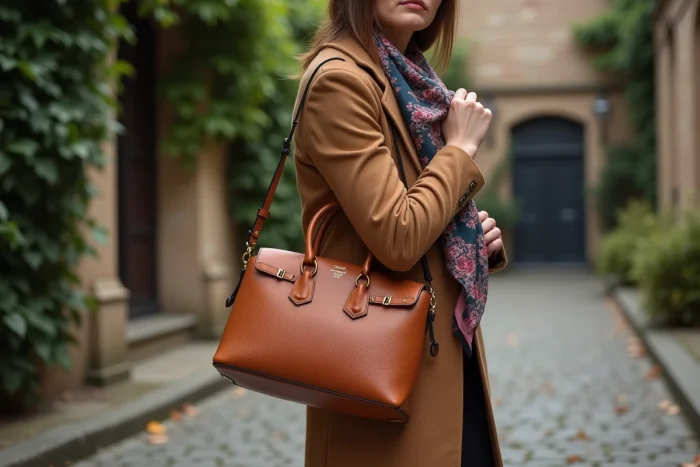
On a bag handle, the gavroche is simply tied in a double loop with a flat knot. The reduced size prevents the fabric from dangling or getting caught in a closure. The silk provides a sharp texture contrast on smooth leather, and the pattern remains more readable than on a large square folded multiple times.
On the wrist, the gavroche functions like a wide bracelet. Folded into a narrow band (about three centimeters), it wraps around twice and is secured with a simple knot. The wrist exposes the border of the square, this area that the neck folding also makes visible, allowing for visual coherence if a second scarf is worn elsewhere.
Silk and daily life: the concrete limits of a fragile accessory
The Hermès silk twill should not be treated like cotton. Prolonged exposure to sunlight alters the colors, and sweat leaves marks on light shades. Wearing a gavroche every day around the neck in summer implies regular washing, which raises the question of maintenance.
Silk can withstand hand washing in cold water with a mild soap, but ironing requires a low-temperature iron on the reverse side of the fabric. A wrinkled or stained gavroche loses the desired effect. Field reports vary on this point: some users wear their gavroche for several seasons without washing, while others notice a rapid dulling of bright colors.
The reduced size of the gavroche offers a practical advantage for rotation: it can be stored flat in a pouch or drawer without taking up space. Alternating between two or three models helps limit wear and adapt colors to the seasons.
The Hermès gavroche square remains a silk accessory, not an interchangeable basic. Its value lies as much in the quality of the fabric as in the precision of the gesture that shapes it. Treating it as a technical piece, with its material and format constraints, yields better results than considering it a mere decorative scarf.