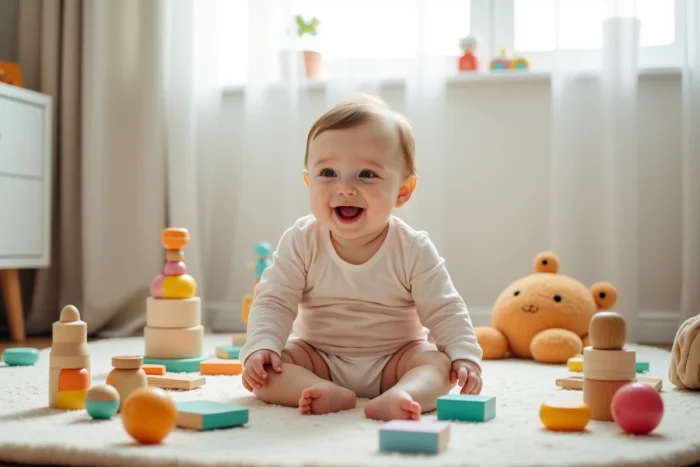
At 8 months, a baby begins to sit up, transfer objects from one hand to the other, and actively search for things that disappear from their field of vision. These motor and cognitive skills guide the choice of developmental toys: the right object is one that accompanies a gesture in the process of learning, not one that simply lights up.
This classification prioritizes toys and activities that engage motor skills, interaction with adults, and sensory exploration, combining commercial products and everyday objects.
1. Treasure basket with everyday objects
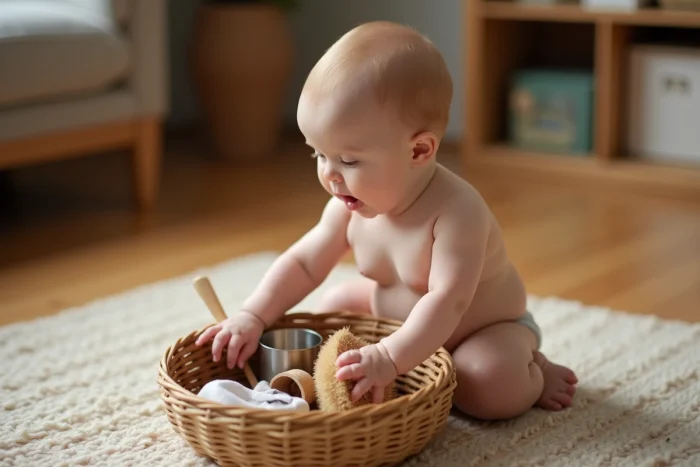
The treasure basket consists of gathering about ten objects with varied textures, weights, and temperatures (wooden spoon, natural sponge, small metal whisk, piece of fabric) in a low container. Placed in front of the sitting baby, it invites them to rummage, grasp, bring to their mouth, and compare.
The adult does not intervene to guide the choice, but remains present to ensure safety. This setup works on voluntary grasping, bimanual transfer, and concentration. No manufactured toy replicates the sensory diversity of real objects as well, provided that no piece is small enough to be swallowed.
To go further, check out these ideas for developmental games for 8-month-old babies that detail other activities suitable for this age.
2. Sensory balls with multiple textures
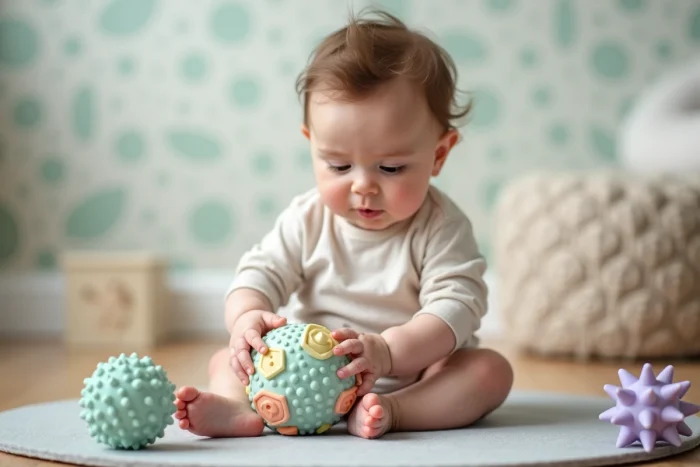
A set of soft plastic or natural rubber balls, each equipped with bumps, ridges, or smooth surfaces, offers a direct tactile exploration ground. At 8 months, the baby starts to throw intentionally: the rolling ball encourages them to crawl to retrieve it.
This link between action and movement makes sensory balls a tool for gross motor skills and hand-eye coordination. Prefer washable models that are large enough not to be fully put in the mouth, and without internal foam that could detach.
3. Wooden shape sorter
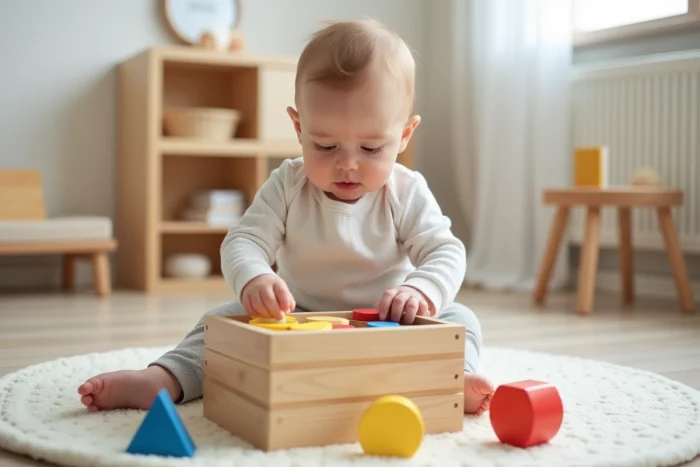
The shape sorter requires the baby to match a volume to an opening. At 8 months, success is still partial: the baby mostly inserts by trial and error. It is precisely this fumbling that stimulates problem-solving and perseverance.
A wooden model with three or four simple shapes (circle, square, triangle) is more than sufficient. Versions with ten shapes discourage rather than stimulate at this age. Solid wood withstands impacts and repeated chewing, two safety criteria for an object that the baby handles intensively.
4. Nesting cups
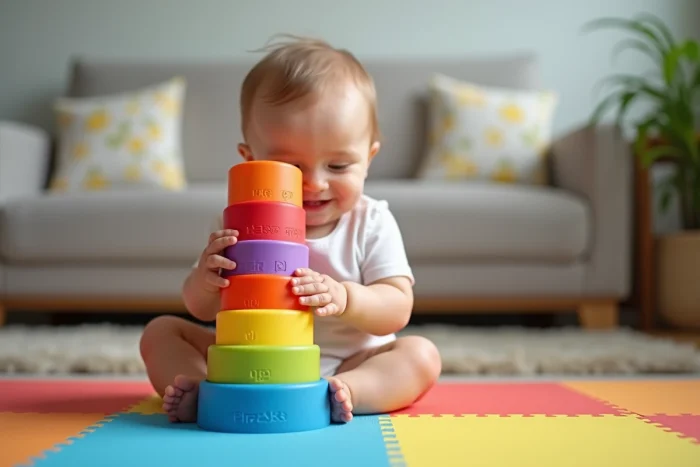
Stacking, nesting, toppling: nesting cups offer open-ended play whose use evolves with the baby’s abilities. At 8 months, the tower systematically collapses, and it is the deliberate destruction that is enjoyable. The child observes the cause (pushing) and the effect (the fall), a fundamental cognitive mechanism.
Also usable in the bath or as sand molds later, these food-grade plastic cups are among the toys with the best usage duration-to-price ratio. Check for the absence of BPA and phthalates on the packaging.
5. Fabric or flap book
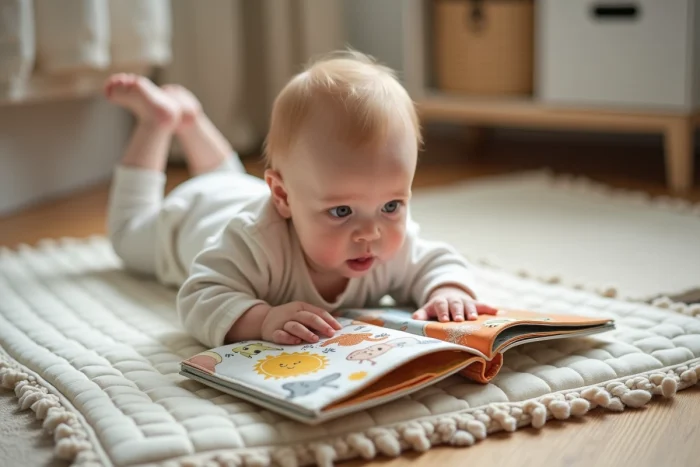
The fabric book withstands saliva, twisting, and throwing. The flap book adds an element of surprise when the baby lifts a flap. Both formats support language development: the adult names what appears, and the baby gradually associates a sound with an image.
Choose books with strong visual contrasts and few details per page. At 8 months, the gaze focuses better on a simple image than on a busy illustration. Two or three rotating books are sufficient to maintain curiosity.
6. Peek-a-boo game with a scarf

Around 8 months, the baby begins to understand object permanence: what disappears still exists. The peek-a-boo game with a simple scarf directly exploits this acquisition. The adult hides their face, the baby pulls the fabric, the surprise provokes laughter, and the cycle repeats.
No purchase necessary. Interaction with the parent takes precedence over material support. This game also strengthens the emotional bond and understanding of turn-taking, the foundation of social communication.
7. Tambourine or small percussion instrument
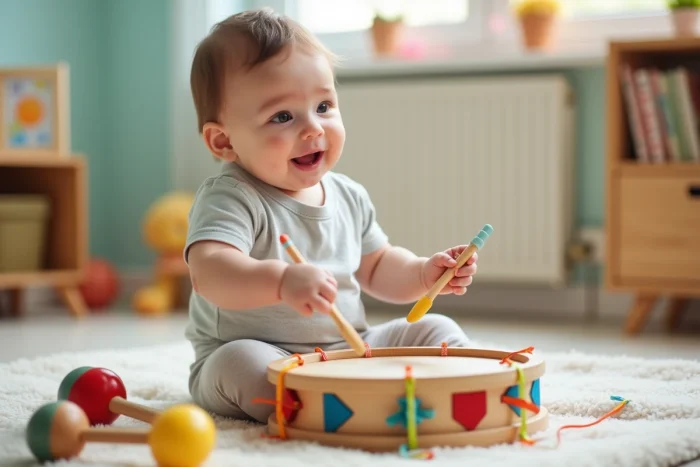
Hitting a tambourine produces an immediate sound proportional to the force of the gesture. The 8-month-old baby makes the connection between their motor action and the sound result, reinforcing the notion of causality. A small wooden tambourine or a sealed grain shaker works well.
Avoid electronic instruments with fixed volume that overwhelm the baby. The sound should vary according to the intensity of the gesture for sensory learning to work. Monitor that the baby does not forcefully bring the instrument to their face.
8. Soft motor skills tunnel
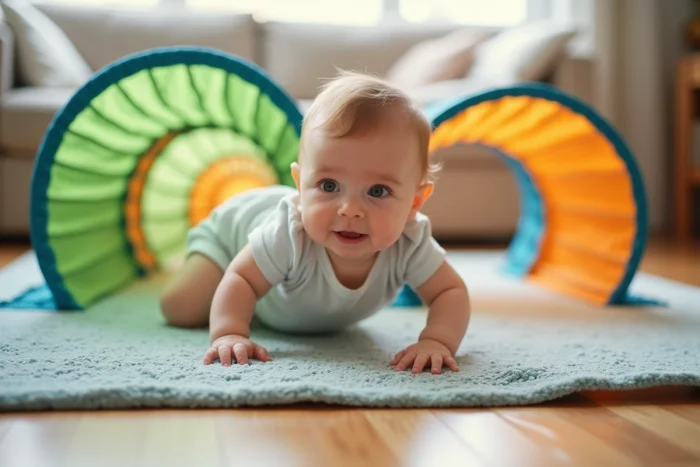
A foldable textile tunnel encourages the baby to crawl to the other end, attracted by a toy or a parent’s face. This crawling movement engages cross-coordination of arms and legs and strengthens the trunk muscles necessary for future walking.
The tunnel works best in an open space, on a non-slip floor. Start with a short tunnel to avoid any apprehension. Some babies refuse to enter: in that case, simply use it as an arch to crawl under on their stomach.
9. Pull or push toy on wheels
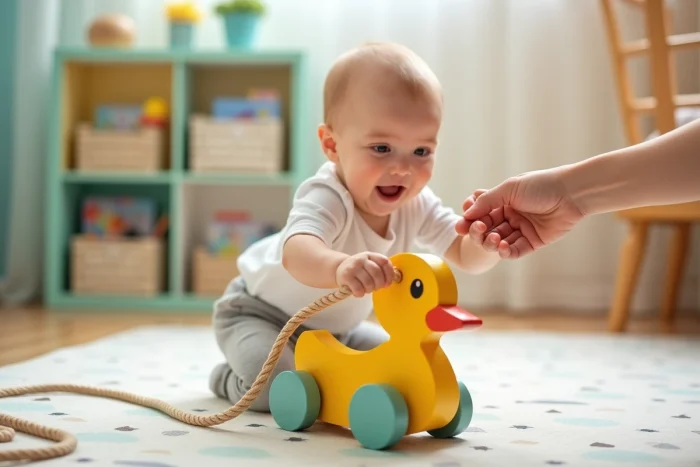
Even though walking is not yet mastered at 8 months, a wheeled toy that the baby pushes while sitting or kneeling encourages weight transfer forward. Wooden models with a wide grip are more stable than lightweight plastic versions.
This toy also prepares for spatial understanding: the baby observes that the object moves forward when they push it, and moves back when they pull it. A use that will continue well beyond 12 months.
10. Pouring activity with bowls and spoons
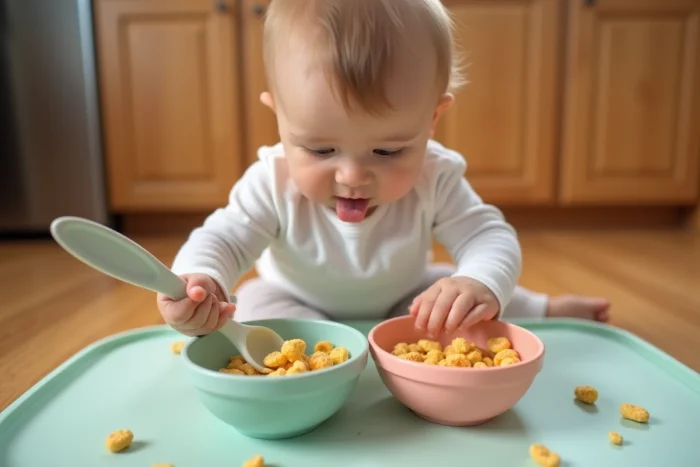
Two unbreakable bowls, a wooden spoon, and some large dry beans (under strict supervision) or pom-poms form a pouring workshop. The baby fills, empties, transfers, and repeats. This activity works on fine pincer grasp and bimanual coordination.
The pouring activity illustrates well the central angle of this classification: activities guided by the adult with common objects stimulate development just as much as a commercial toy. The only condition remains constant supervision to avoid any risk of ingestion of small elements.
Half of the most effective developmental games at 8 months cannot be bought in stores. A scarf, two bowls, and a few kitchen items are enough, provided the adult accompanies the play and adjusts the difficulty to the baby’s progress. The most expensive toy left alone in a playpen will never replace this interaction.