
Designing a custom bookshelf is not just about choosing a height and width that “fit” into a wall. The dimensions of the items to be stored, the nature of the load-bearing wall, and the fixing constraints determine each measurement, sometimes to the nearest centimeter. Asking the right questions before starting production avoids costly revisions and, in some cases, safety issues related to load.
Permissible load and wall type: the parameter that catalogs ignore
Most sizing guides start from the content (books, decorative objects) to arrive at the dimensions of the furniture. This approach overlooks a crucial factor: the load capacity of the wall to which the bookshelf will be fixed. On a stone or concrete wall, this question rarely arises. On a drywall partition, the situation changes.
Manufacturers of fixing systems like Placo, Knauf, or Fischer have been publishing more detailed load tables since 2022. These data show a downward trend in the permissible load per fixing point on lightweight partitions, especially when exceeding certain heights or shelf depths.
The lever effect increases with depth: a deep shelf loaded with art books exerts more pull on the upper fixing than a shallow shelf filled with paperback novels.
To know the ideal dimensions for a bookshelf, it is necessary to cross-reference two data points: the format of the stored items and the actual strength of the wall support. Ignoring either leads to either an undersized piece of furniture or a risk of detachment.
The load recommendations from the Technical Opinions of the CSTB (Scientific and Technical Center for Building) or European ETAs serve as a reference. Several home insurers are beginning to require compliance with these standards for wall-mounted bookshelves installed above a certain height, particularly in multi-family housing and public spaces.
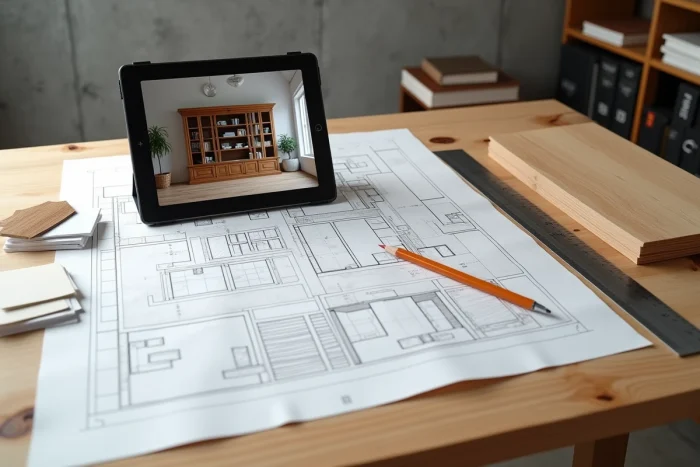
Shelf depth: the most underestimated dimension
Depth is the parameter that generates the most regrets after installation. If too shallow, large formats stick out from the shelf. If too deep, small books get lost at the back, and the whole looks disproportionate in the room.
Usable depth and total depth
Usable depth corresponds to the actual space available between the back and the front edge of the shelf. It differs from the total depth of the furniture, which includes the thickness of the back panel, any mounting play, and the setback from the wall. For a piece of furniture with an overall depth of thirty centimeters, the usable depth can be reduced by several centimeters.
For mixed use (novels, comics, a few art books), a usable depth of around twenty centimeters covers most common formats. Art books or encyclopedias require more, typically around thirty centimeters of usable depth. It’s better to plan one or two deeper shelves dedicated to large formats than to standardize the entire bookshelf to the maximum dimension.
Thickness of shelves and span
The thickness of the shelf panel determines the maximum span without visible bending. A panel that is too thin over a large width will eventually bend under the weight of the books, even if the total load remains moderate.
Narrowing the width between uprights limits this risk much more effectively than thickening the shelf. Field reports vary on the exact thresholds, as they depend on the material (MDF, plywood, melamine, solid wood), but the principle remains constant: the shorter the span, the more the shelf withstands over time.
Shelf height: adapting dimensions to actual content
Competing contents often provide a single height table by book format. This approach works if your collection is homogeneous, which is rarely the case. Relevant sizing starts with an inventory, even a rough one, of what you own and what you plan to store.
- Paperbacks require a free height of about eighteen to twenty centimeters, including handling margin. Cramping the shelves to the millimeter makes extraction difficult and accelerates wear on the bindings.
- Standard format comics need a slightly higher height, around twenty-five centimeters. Hardcover collections can go higher.
- Art books and coffee table books vary widely. If you own about ten, measure the largest and add a few centimeters. There’s no need to calibrate an entire row based on a single oversized book.
- Non-book items (vinyl records, frames, hi-fi equipment) have their own dimensions. Integrating them from the design stage prevents ending up with unusable shelves.
Varying the height of the shelves within the same piece of furniture yields a more functional result than a uniform grid. Planning adjustable shelves on brackets offers flexibility, provided the bracket holes are close enough together.
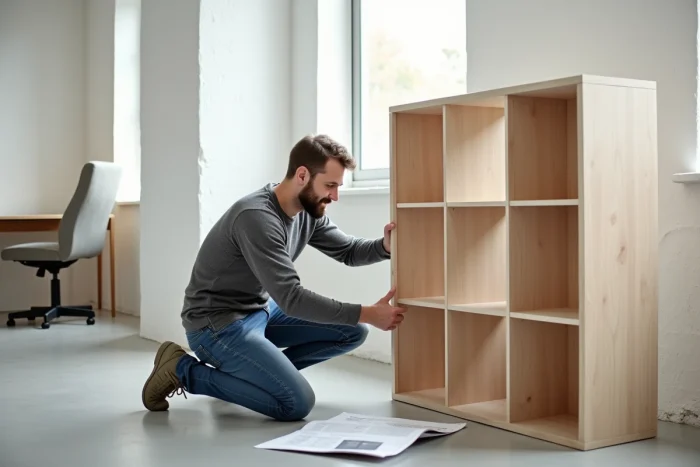
Spacing of fixings and total height of the furniture
The total height of a custom bookshelf depends as much on aesthetic ambition as on often overlooked technical constraints. Beyond a certain height, the furniture must be securely fixed to the wall, even if it is freestanding. The tipping of a loaded bookshelf poses a real risk, especially in a household with children.
The spacing of wall fixings influences stability as much as their number. A spacing that is too wide between two anchor points concentrates the forces on each fixing. The Technical Opinions of the CSTB provide reference values according to the type of wall. On a drywall partition, the recommended spacing will be tighter than on a masonry wall.
For furniture that reaches the ceiling, the question of the upper module arises: a shelf located more than two meters high is difficult to access without a ladder. Assigning it a generous height for storing rarely handled items (archives, books seldom consulted) optimizes space without complicating daily life.
Custom bookshelf in a small space: balancing depth and circulation
In a hallway, a compact office, or a studio, every centimeter of depth taken by the furniture reduces the circulation area. Accessibility standards recommend maintaining a sufficient clear passage to avoid hindering movement, including with a wheelchair in the relevant spaces.
Choosing a reduced depth throughout and reserving only one deeper lower module for large formats constitutes an effective compromise. This configuration preserves visual clearance while providing enough storage capacity.
- Measure the residual circulation space before finalizing the depth of the furniture, not after.
- Favor sliding doors or no doors to avoid encroaching on the passage.
- Anticipate integrated lighting: a LED strip at the back of the shelf adds a few millimeters of depth to the furniture, to be included in the calculation from the start.
The sizing of a custom bookshelf relies on a balance between the content to be stored, the strength of the supporting wall, and the available space in the room. Fixing just one of these three variables without considering the other two results in furniture that disappoints in use, regardless of the care taken in its finish.