The French regulations require a smoke detector certified EN 14604 per housing unit. This minimal standard is met by most households. The question today is no longer just about this single detector, but about the coherent assembly of equipment capable of covering several types of risks: intrusion, fire, technical failure of access points.
Cybersecurity of connected devices: the criterion that guides overlook
Smartphone-controlled alarms, remotely accessible surveillance cameras, connected locks: these devices almost all rely on a connection to the manufacturer’s cloud. This permanent link creates a dependency that is rarely mentioned at the time of purchase.
A connected alarm system whose manufacturer stops its software updates becomes vulnerable within a few months. Unpatched security flaws allow a third party to disable a camera or unlock a connected lock. The update policy determines the actual lifespan of the system.
Before comparing prices, it is better to check three points for each connected device considered: the frequency of firmware updates published by the manufacturer, the robustness of user account authentication (two-factor or not), and the system’s operation in case of cloud failure. A device that becomes unusable if the remote server goes down protects nothing at all.
Among the equipment on Protect Habitation, several categories allow for the comparison of these technical criteria before a purchase.

Layered protection: alarm, detection, and deterrence combined
Recent recommendations from prevention stakeholders converge towards a layered approach rather than the purchase of a single device. Prevention, detection, deterrence, and remote alert form a set where each link compensates for the weaknesses of the others.
The physical layer first
Reinforcing openings remains the most cost-effective action. The majority of intrusions exploit a poorly closed door, a fragile window, or a low-quality lock cylinder. Replacing a cylinder with a model resistant to pulling and picking takes less than an hour and changes the behavior of an opportunistic burglar, who prefers easy targets.
Outdoor lighting with motion detection adds a layer of visual deterrence. This type of equipment requires no subscription and operates autonomously.
The electronic layer next
Opening sensors placed on windows and doors constitute the first level of detection. Coupled with an alarm control panel, they trigger a local siren and, depending on the system, a notification on a phone or a call to a monitoring center.
Video surveillance completes this network by providing visual proof. However, a camera alone, without an alarm or sensor, merely records an ongoing burglary without preventing or interrupting it. A camera without an alert system does not protect; it documents.
- First layer: reinforced lock, solid shutters, outdoor lighting with detection. No subscription, immediate effectiveness against opportunistic attempts.
- Second layer: opening sensors and alarm control panel with mobile notification. Detects intrusion and triggers an audible response.
- Third layer: surveillance cameras and monitoring contract. Provides visual proof and the possibility of remote human intervention.
Wired or wireless alarm: what changes depending on the housing
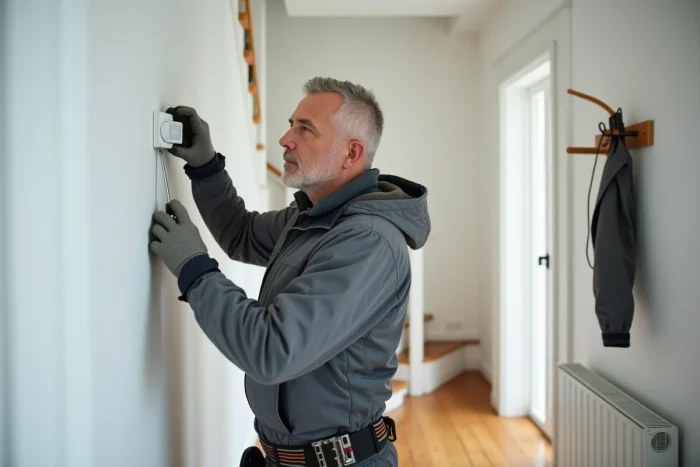
The choice between a wired alarm and a wireless alarm primarily depends on the housing configuration. In a new house or undergoing heavy renovation, running cables through the walls remains possible. The wired system then offers reliable transmission without the risk of radio interference.
For an already furnished apartment, the wireless alarm can be installed without heavy work. Recent models use diversified frequencies to limit the risk of interference. Field reports vary on this point: some installers report interference in older buildings with thick walls, while others never encounter it.
The type of housing determines the choice, not the budget. A wireless system poorly suited to the configuration will cost more in maintenance and false alarms than a wired system installed from the start.
- Individual house under construction: prefer wired, integrated into the electrical plan. Maximum stability, no batteries to replace.
- Apartment or old house without planned renovation: wireless remains the most realistic solution. Check the range of the sensors and compatibility with wall thickness.
- Mixed housing (recent extension on old building): a hybrid system, combining wired in the new part and wireless in the existing, can avoid compromises on coverage.
Smoke detector and beyond: covering risks that the alarm ignores
The smoke detector certified EN 14604 meets the legal obligation. It detects combustion smoke in living areas. However, it does not cover carbon monoxide, an odorless gas produced by a faulty boiler, poorly maintained wood stove, or blocked flue.
A carbon monoxide detector remains optional in France, but its installation in homes equipped with a combustion appliance (gas, wood, oil) is a matter of technical common sense. The smoke detector does not protect against carbon monoxide.
Technical areas (garage, laundry room, boiler room) deserve special attention. A fire starting in a technical room often spreads before the smoke reaches the detector placed in the hallway. Positioning an additional detector near these areas reduces the alert delay.
The choice of security equipment for a home relies less on the accumulation of devices than on their coherence. A reinforced lock, opening sensors connected to a control panel, deterrent lighting, and detectors covering smoke and carbon monoxide form a set where each element has a specific function.
The weak link often remains maintenance: batteries not replaced, updates ignored, camera whose angle has shifted. A well-chosen but poorly maintained system protects very little.