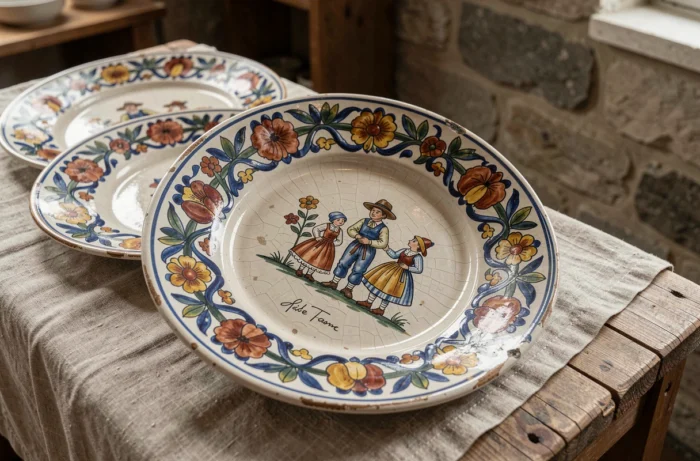
Quimper faience refers to ceramic production that began in the late 17th century in the Locmaria district and was carried on by several successive manufacturers. At auction, not all pieces stamped Quimper are worth the same. The Henriot-Quimper mark alone is not enough to justify a high value: the hammer price depends on the combination of precise attribution, form, decoration and condition.
Attribution and signature: what sets a documented piece apart from an “exceptional” object
When a piece of Quimper faience is presented as rare, the first step is to verify its attribution. The Porquier, HB (la Grande Maison) and Henriot manufactories produced thousands of designs over three centuries. A decoration signed by an identified artist, such as Robert Micheau-Vernez, Mathurin Méheut or René Quillivic, attracts more attention from collectors than an unsigned piece with traditional Breton decoration.
An artist’s name does not necessarily guarantee a high auction price. Results vary depending on the object, its production period and the strength of the attribution. A piece clearly documented in a manufactory catalogue, with a model number or traceable provenance, carries more weight than an object attributed “after” or “in the style of.”
To assess the market value of Quimper faience, several factors must be considered together: the mark on the reverse, any signature by the decorator, and whether the style of the decoration is consistent with the claimed period. A piece whose origin is uncertain between Quimper and another manufactory (Malicorne, Desvres) is less clear-cut for a knowledgeable buyer.
Rare forms and unusual decorations at Quimper faience auctions
Plates decorated with Breton figures are at the heart of Quimper’s production. They remain affordable and widely available. It is unusual forms that create a stir in the auction room: sculpted objects, furniture, decorative instruments and monumental sets.
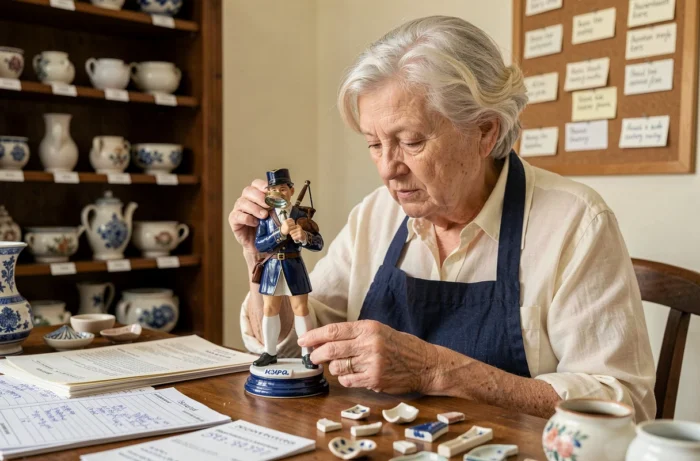
A telling example is a 19th-century French faience mandolin, tentatively attributed to Quimper or Desvres, which sold for 2,500 euros in 2009. This result illustrates two things at once: the appeal of rare forms and the caution required when the origin is uncertain. The buyer paid for a distinctive object, but its attribution to two production centres makes direct comparisons with other Quimper pieces impossible.
Méheut’s animal sculptures for Henriot, such as the rooster-and-hens group or the fishmonger figures, belong to a different category. Their attribution is clear and their distribution is documented, making it easier to find reliable comparables when valuing a similar piece.
Grouped lots and individual pieces: how to read auction results correctly
A common pitfall is comparing the price of a dinner service with that of a single piece. A complete service, for example, with 18 dinner plates, 12 soup plates, 12 dessert plates, a tureen and a jug, may achieve a high total price which, divided by the number of pieces, gives a negligible unit value. Conversely, an individual object that looks modest may exceed estimates because its design is rare.
Mechanically converting a lot price into a unit price distorts the valuation. The value of a set often lies in its completeness and consistent condition, not in each item considered separately. An incomplete or mismatched service loses a significant part of its appeal.
To determine the value of a piece, three checks are essential:
- Look for auction results for an object of the same form, from the same manufactory and period—not simply “Quimper faience” in the broad sense
- Distinguish sales of individual pieces from sales of grouped lots in the results you consult
- Check whether the comparable piece was in original condition or restored, as the price difference can be considerable
Condition and the market value of antique faience
A chip on the rim of a common plate makes little difference to its market value, which is already modest. On a rare piece, even the slightest visible flaw reduces its appeal to discerning collectors. Cracks, chips around the handles and old repairs are the most common defects in Quimper faience, given the fragility of the material.
Collectors generally look for pieces in near-original condition. Professional restoration can make an object presentable, but it remains detectable under UV light and gives the buyer grounds for negotiation. Transparency about condition in an auction catalogue or item description is a sign of professionalism.
What comparisons with actual auction results reveal
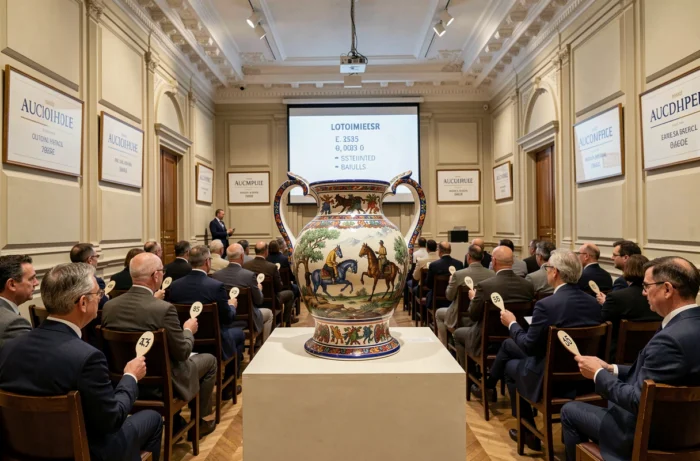
A hammer price is not an estimate: it reflects the balance of competition between bidders at a particular moment. Two identical pieces can sell for very different amounts depending on the sale, the audience and market conditions. Available results for Quimper faience show a highly variable market, depending on the artist, design and composition of the lot.
Using auction results as comparables rather than direct estimates remains the most reliable way to gauge a piece’s value. Comparing several results for genuinely equivalent objects gives a more realistic range than relying on a single spectacular price found online.
Quimper faience continues to appear in large quantities at auctions in Brittany and Paris. The difference between a piece worth a few dozen euros and an object worth several thousand rarely comes down to chance: it can be seen in the attribution, form, condition and quality of the comparables used to value it.