
Organising your time between work, personal projects and private life is about more than simply choosing a productivity method. The legal framework, employment conditions and the level of autonomy you actually have in your role determine much of what is feasible day to day. Before choosing a planning tool or technique, assessing these constraints can help you avoid strategies that are impractical.
Legal framework and the right to disconnect: what really shapes your schedule
Most time-management guides treat organisation as an individual problem. Yet part of the issue is collective and regulatory.
Since the law of 8 August 2016, the French Labour Code has included the right to disconnect in mandatory negotiations on professional equality and quality of life at work. If no company agreement is in place, the employer must draw up a charter after consulting the CSE.
In practice, responding to work-related requests in the evening or at weekends is not a personal organisational failing. It is a matter governed by the agreements that apply within your company. Before rearranging your evenings, check whether a charter or agreement already sets out availability hours in your organisation.
This can make a real difference when balancing work and personal projects: the time reclaimed from out-of-hours requests is often the most valuable for making progress on a creative project, training or family time. Resources such as 16h20.fr offer further insights into ways to structure your time day to day.
Remote work and time management: a benefit not everyone can access
Remote work is often presented as the solution for better balancing different activities. The reality is more nuanced.
According to Insee data cited in several recent analyses, jobs that can be done remotely are far more common among managers than among manual workers. Organising your day around flexible time slots or choosing where you work depends on having a job that allows it, which rules out a large proportion of employees.
In addition, large French companies have been moving towards tightening some remote-work arrangements. The rules actually in force at your company take precedence over generic advice on flexible working.
How remote work changes task management
The time saved on commuting is real, but it can obscure another challenge. Working remotely shifts when collaboration takes place: video meetings, asynchronous exchanges and team coordination. If these collaborative activities are not scheduled, they eat into the focus time that is supposed to be the main advantage of working from home.
Organising your schedule when working remotely therefore means distinguishing between two types of time slots:
- Collaboration time (meetings, replies to team messages, check-ins), grouped into fixed half-days to avoid fragmentation
- Individual work time, protected by a clear status (notifications off, calendar blocked) and dedicated to tasks that require concentration
- Transition time, even if brief, to mark the boundary between work and personal life when home is also the office
Balancing work and personal projects: comparing time-allocation strategies
Time-management methods do not produce the same results for every type of activity. The table below compares three common approaches to balancing work, projects and personal life.
| Strategy | Principle | Suitable for personal projects | Main limitation |
|---|---|---|---|
| Fixed time blocks | Assign a recurring time slot to each area (work, project, rest) | Yes, if the time slot is protected from interruptions | Rigid and difficult to maintain when working hours vary |
| Daily prioritisation (Eisenhower-style) | Sort each task by urgency and importance every morning | Not really, because personal projects are rarely urgent and are consistently pushed back | Long-term projects are always postponed |
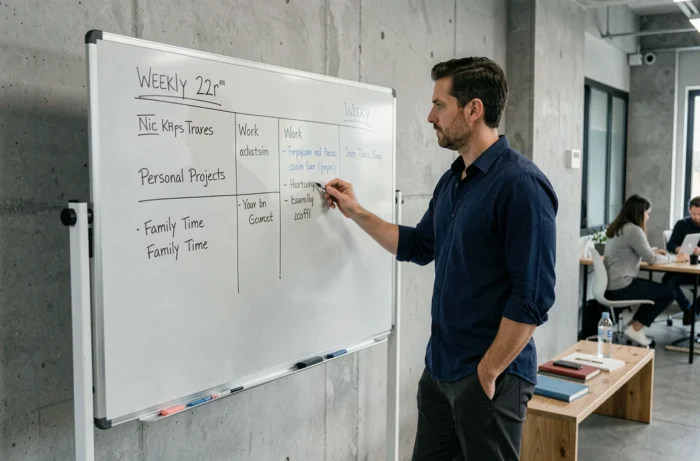
| Weekly planning by role | Set goals each week for each role (employee, parent, project lead) | Yes, because the project is guaranteed a place in the week | Requires a disciplined weekly review |
The key takeaway from this comparison is that methods focused on daily urgency crowd out personal projects. A creative project, training or community commitment is almost never urgent. It always ends up at the bottom of the list.
Weekly planning by role, where each area of life is given a concrete goal for the week, does a better job of protecting non-urgent activities. It requires you to make trade-offs in advance rather than simply reacting to urgent demands throughout the day.

Planning tools: what works depending on how much control you have
An organisational tool is only useful if it matches the degree of control you have over your schedule. Someone who can manage their hours freely has different needs from an employee with fixed working hours.
High level of control over working hours
A digital calendar with colour-coded blocks for each area (work, projects, personal) is enough in most cases. The aim is to see how your time is actually distributed across the week and spot imbalances before they become entrenched. A 15-minute weekly review is more useful than any app.
Fixed hours with little flexibility
When there is little room to manoeuvre, the strategy is to identify recurring micro-slots: your commute, lunch break or time in the morning before work. The trap is trying to fill them all. It is better to protect two time slots a week for a specific project than to scatter 15 minutes each day across three different activities.
- Identify the two or three fixed time slots genuinely available each week, without excessive fatigue or conflict with family life
- Assign each slot to a single project or personal activity, never to catching up on work
- Review each month whether these slots are leading to tangible progress, and adjust if the project is stalled
Balancing work, projects and personal life does not depend on a single method. It depends first on your actual circumstances (contract, company agreements, whether you work remotely) and then on choosing a planning strategy that protects non-urgent activities from the pressures of everyday life. When effectively enforced, the right to disconnect remains one of the most practical ways to reclaim time from excessive work-related requests.