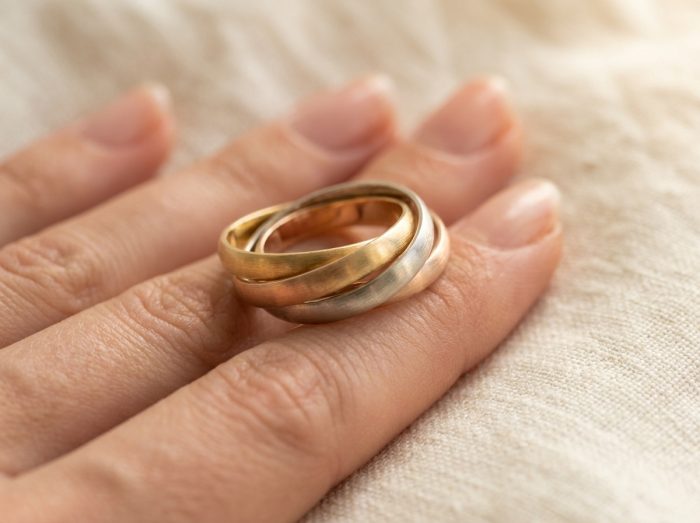
When wearing a three gold ring daily, one quickly notices a practical detail: it matches with all the other jewelry already present on the wrist or ears. Yellow gold on one side, silver on the other, rose gold earrings in the middle, everything works together effortlessly. It is this concrete versatility, more than the symbolism, that explains the current enthusiasm of luxury jewelry enthusiasts for this type of ring.
Three Gold Ring and the Mix and Match Metal Trend
The classic reflex was to strictly match the color of one’s jewelry: all in yellow gold or all in silver. Since the end of the 2010s, this rule has been shattered. European trend reports indicate a clear acceptance of metal combinations in the same outfit, and tricolor rings are cited as a prime example of this evolution.
In practice, the three gold ring acts as a pivot. Worn alone, it already creates a play of contrasts between yellow gold, white gold, and rose gold. When paired with other pieces, it visually connects jewelry of different colors without any coordination effort. This is a real time-saver when getting dressed, and a point that jewelry salespeople know well.
The Trinity Ring by Cartier remains the historical reference for this tricolor approach. Created in the 1920s, it has crossed a century without major modifications to its design, proving that the idea of mixing three shades of gold into a single piece of jewelry is not a fleeting fashion whim.
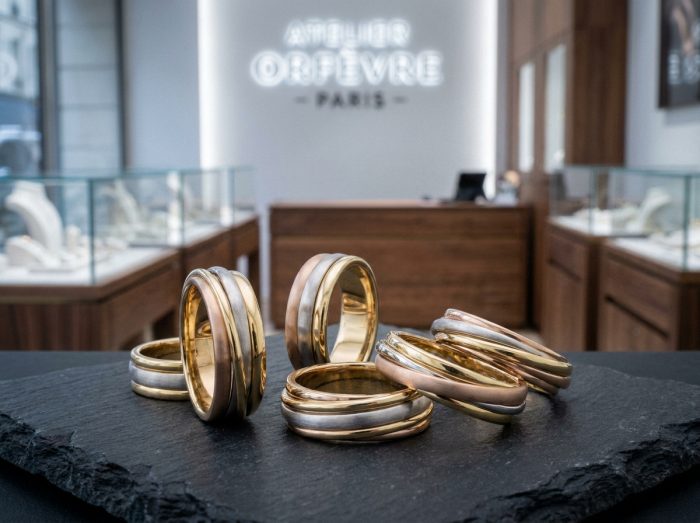
Composition and Technical Specificities of the Three Golds
Talking about “three golds” means discussing three distinct alloys, each with its properties. Pure gold (24 karats) is too soft for jewelry. It is therefore mixed with other metals to achieve the desired hue and hardness.
- Yellow Gold: an alloy of pure gold with copper and silver. It is the color closest to natural gold, with a warm and bright shine.
- White Gold: an alloy of pure gold with palladium or nickel (depending on the manufacturers), often coated with rhodium to enhance its brilliance. Its appearance resembles platinum, usually at a lower price.
- Rose Gold: an alloy of pure gold with a higher proportion of copper than in yellow gold, giving it that characteristic pink hue. Its hardness is slightly greater than the other two.
On a three gold ring, these alloys coexist within the same piece of jewelry. The technical difficulty lies in the assembly: the three metals do not expand in exactly the same way with heat. A skilled jeweler must master the welding and polishing of each section without altering the neighboring color.
Impact of Size and Carat Weight
Most three gold rings on the market are offered in 18 carats (750 thousandths of pure gold). This carat weight offers the best compromise between color richness and mechanical resistance. Below that, at 14 or 9 carats, the hues lose depth, especially rose gold which turns a dull coppery shade.
The size of the finger also influences the visual effect. On a narrow band, the three colored stripes are tight and the contrast is less readable. Wider models, starting from 4 or 5 mm, allow each shade to express itself. This is a point to check before purchase, especially for small finger sizes.
Why Three Gold Rings Appeal to the Luxury Market in 2024-2025
High jewelry houses have placed this format at the center of their recent campaigns. Cartier has relaunched dedicated operations for the Trinity model by associating it with young ambassadors like Emma Corrin and Paul Mescal, with a clear intention: to reposition the three gold ring as an intergenerational piece of jewelry, no longer just a classic reserved for an older clientele.
This repositioning works because it is based on a market reality. The three gold ring is not tied to a unique occasion (engagement, marriage). It is worn daily, passed down, and layered. Its style transcends decades without appearing dated, making it a rational purchase for those seeking a luxury piece to wear for a long time.
The investment aspect also plays a role. In a context where gold prices fluctuate, owning a piece made of three 18-carat gold alloys represents tangible value. Returns on this point vary by market, but the resale of a signed three gold ring remains generally smoother than that of a high-end costume jewelry piece.

Vintage Three Gold Rings: Authenticating and Buying a Second-Hand Piece
The second-hand jewelry market has gained credibility in recent years, notably thanks to more rigorous expertise processes. Buying a vintage three gold ring allows access to models that are no longer in production, sometimes at a lower price than new, while wearing a piece with a story.
Here are a few points to check before a vintage purchase:
- The hallmark (eagle’s head for 18-carat gold in France) must be legible. If it is worn away, request independent expertise.
- The condition of the rhodium on the white gold part: a worn rhodium can be easily redone at a jeweler, but it is an additional cost to anticipate.
- The consistency of the welds between the three colored sections. Signs of poorly executed repairs can weaken the structure.
For those looking for a signed three gold ring second-hand, the marketplace castafiore offers a catalog of over 10,000 pieces of vintage jewelry and watches, expertly evaluated and authenticated before sale. The platform covers creations from major houses as well as unsigned pieces. A digital certificate of authenticity recorded in the blockchain is provided within 15 days after purchase, allowing you to buy a vintage piece at a fair price without doubting its authenticity.
The three gold ring remains one of the few luxury pieces that does not depend on a central stone or a fashion trend to justify its price. Its elegance comes from the metal itself, the technical mastery of the assembly, and its ability to integrate into any style. It is a piece of jewelry that one buys once and wears for years, which, in the world of jewelry, is no small matter.