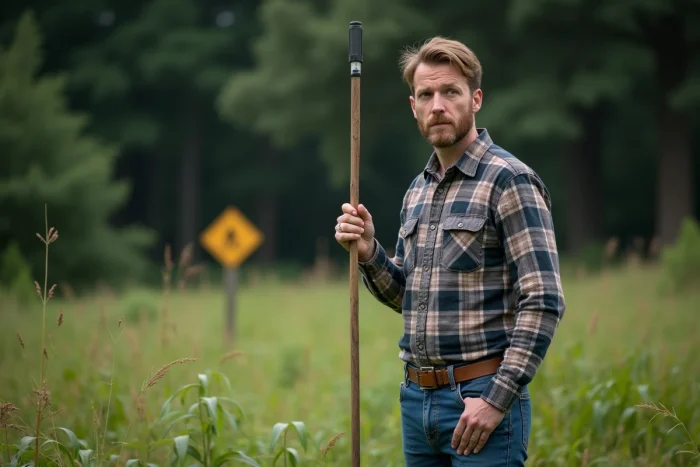
An object without a manual, but whose use can provoke very real tremors: the divining rod escapes any regulation on French territory. Yet, several public reports have already pointed out its hazardous uses, particularly in contexts where safety takes precedence over tradition. Some local authorities and companies have not given up on the rod to locate water or buried resources. This choice, in the absence of scientific validation and in disregard of certain legal risks, has already led to problematic situations. Recent events remind us that the popularity of the rod should not overshadow the need for a strict framework.
The divining rod: enduring traditions, tenacious beliefs
Seemingly modest, the divining rod holds a special place in rural memory. It transcends time, passed down from generation to generation, often kept as a family secret. It is always imagined in the hands of a villager, traversing fields and meadows in search of an elusive water table. While hazel and witch-hazel have long dominated for their flexibility, modernity has led some to opt for copper, brass, or synthetic materials. In Y, twisted into L, graduated… The variations are numerous and testify to a practice that continues to reinvent itself. What is at play behind the rod is called radiesthesia. This term refers to both the handling of the pendulum and the claim to capture invisible waves or influences. Yves Rocard, a famous physicist, looked into the matter without providing any definitive proof. Two camps clash: those who see it as a tradition on the border of divination, and those who consider it nothing more than persistent superstition. Radiesthesia sometimes extends its territory to the location of objects or telluric currents, far from the simple detection of water. Passed down through word of mouth, this fascination sometimes obscures caution. Those who practice know what they expose themselves to. Without serious experience, handling a rod risks slipping into states of mental confusion or esoteric drifts. For those wishing to delve deeper into the subject, the article the dangers associated with the divining rod reminds us how these risks remain largely ignored by the general public. Between intimate belief and lack of validation, the debate never quite dies down, imposing a necessary caution.
What unknown risks lie behind the use of radiesthesia?
Radiesthesia sometimes transcends the simple framework of water searching to venture into areas where all rational reference wavers. The rod, an innocuous object in appearance, then becomes a tool to explore “subtle energies”: terrestrial magnetic fields, buried memories, invisible entities. Words blur, beliefs intertwine. Many people unknowingly expose themselves to influences they deem “negative”: old memories, geobiological faults, or entities. Some associate radiesthesia with energy healing, purification rituals, which adds a layer of confusion. Loss of bearings, rising anxieties, a tendency to attribute every phenomenon to external forces: all reactions that can arise quickly. It is no surprise, since official science has never managed to confirm the effectiveness of these techniques. Experience then becomes a slippery ground, where subjectivity and superstition invite themselves.
To better understand the dangers identified by those who know the practice well, it is useful to list the main pitfalls encountered:
- Unexpected reactions of the rod, influenced by the magnetic field or the environment.
- Results dependent on the emotional or mental state of the dowser.
- Gradual rooting of irrational beliefs fueled by the surroundings.
- Unpredictable psychic effects in individuals unprepared to manage this kind of practice.
When radiesthesia flirts with occultism or shamanism, rituals emerge aimed at detecting, purifying, or communicating with invisible forces. For those starting without guidance, the most insidious trap remains the spiral into an anxiety-inducing esotericism, where mental balance wavers.
Better understanding the precautions to take for responsible practice
Taking a divining rod in hand is not just prolonging a gesture from the past. It is engaging in a field where rigor and clarity of mind weigh as heavily as dexterity. Serious training, long-term practice, is what allows one to avoid many disillusionments or drifts. Appropriating an object loaded with meaning without preparation exposes one to all sorts of misinterpretations or irrational fears. The choice of material, whether hazel, witch-hazel, copper, or brass, directly influences the sensitivity and suitability between the tool and the person. Many recommend favoring a rod shaped by a craftsman or made from a carefully selected branch, a guarantee of true “affinity.” Length and shape also play a role: a poorly proportioned tool distorts all perceptions. With experience, some have established psychic protections: centering techniques, energy preparation, control of vibrational frequency. Others mention chakra adjustments or ensure to eliminate any source of “interference.” Behind all these precautions lies the same intention: to keep a cool head, preserve clarity of mind, and not blur the boundary between sensations and collective imagination. Approaching radiesthesia with discernment means distinguishing between what one senses and what one projects. It is better to view the rod as an extension of one’s own intuition, not as a source of absolute truth. And to keep in mind, with each use, that the object produces no more than what one is willing to see in it. This is the paradox: sometimes, the truth hides less in the ground than in the hands and mind of the seeker.