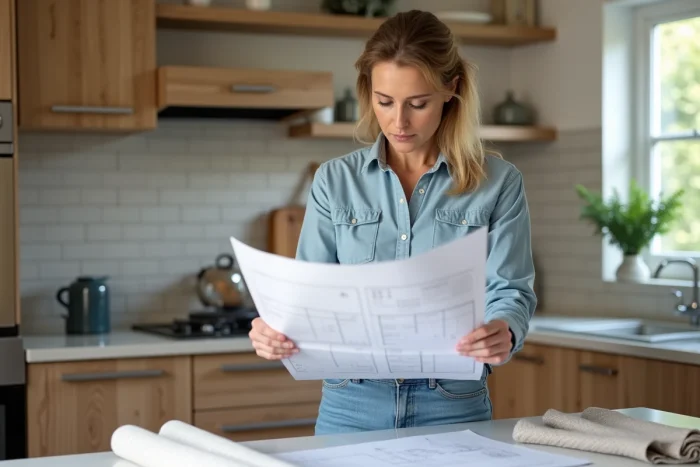
More than 30% of development projects fail due to poor phasing or insufficient anticipation of technical constraints. Some materials show unexpected performances depending on their initial use, contradicting classic recommendations. Local regulations sometimes impose administrative procedures even for seemingly minor work.
The success of a development project rarely relies on a single decisive choice, but rather on a succession of adjusted decisions made at the right time, taking into account the specificities of each space and evolving needs. Layout errors are difficult to correct afterward, while prevention remains accessible to all.
Understanding the stakes of a successful interior layout
Thinking about an interior layout goes far beyond a simple exercise in style. Here, the house plan interacts with light, the terrain, constraints, and the daily rhythm of the inhabitants. Designing a future home or transforming an apartment requires anticipating orientation, volumes, openings, and circulation. When a house adjusts to the lifestyle of its occupants, it gains comfort over time.
Opting for compact architecture helps limit energy consumption and simplifies integration on the plot. Placing living spaces to the south, positioning technical areas to the north, adjusting distribution to natural light: each of these decisions influences energy performance and quality of life on a daily basis. The terrain also imposes its own constraints: slope, access, vegetation, dimensions. Neglecting these elements amounts to sabotaging the very foundations of the project.
Space optimization requires a precise reading of needs, whether for family life, working from home, or evolving uses. A house should be able to evolve, accommodate a home office, or transform a bedroom according to life’s changes. Considering these adjustments from the design stage avoids heavy and costly interventions later. For those who wish to delve deeper into these tips for success in their project, it is possible to learn more about Ma Maison Info, a reference source for all demanding project holders.
Working with an architect or a designer helps find the right balance between technical constraints, aesthetic ambitions, and budget compliance. Their professional perspective ensures the coherence of the plan, compliance with standards, and consideration of sometimes complex urban planning rules. Designing an interior is not about filling the space, but about revealing its qualities, structuring a pleasant, bright, practical, and evolving place.
What are the pitfalls to avoid and the best practices to adopt?
Before starting any work, secure a clear budget, validated at each stage. Too many homeowners embark on their renovations without solid financial planning and discover unexpected costs that burden their project along the way. Defining priorities makes all the difference. It is essential to start with an honest assessment of the premises: structure, insulation, technical networks. Energy renovation work, carried out by qualified professionals (RGE, Qualibat labels), entitles you to aids such as MaPrimeRénov or the zero-interest eco-loan.
Taking the initiative is crucial, both for the choice of materials and for the phasing of the work. Prioritizing solid and efficient materials ensures the durability of the whole. Decoration, on the other hand, deserves some perspective: it should accompany the use of the space, whether for living, renting, or reselling.
Complying with current standards is not optional: PLU, thermal regulations, fire safety, accessibility. A well-managed project requires regular presence, detailed follow-ups, and communication with artisans to quickly detect any discrepancies or defects in execution.
Here are some winning practices to integrate into your organization:
- Plan each phase of the work
- Have choices validated by a project manager or architect
- Opt for effective solutions: multifunctional furniture, optimized storage, smooth circulation
A carefully managed project, compliant with regulations and designed to last, reveals the true value of every square meter.

Concrete tips to transform each space according to your needs
Each room holds unsuspected possibilities. For a master suite worthy of the name, count at least 14 m²: bedroom, shower room, dressing room, sometimes a small office or living area depending on habits. Modularity becomes an asset, especially with sliding doors that facilitate circulation and let in light. The space under the stairs can be utilized: shelves, closets, or even a discreet pantry, everything can be optimized.
In the bathroom, layout should not be improvised. A passage in front of the bathtub requires 55 cm, 70 cm in front of the sink or shower, and 60 cm to access the toilet. These benchmarks guarantee both comfort and practicality. Grouping water rooms simplifies plumbing, limits costs, and improves thermal comfort. For a couple, a 4 m² shower room is sufficient; for a family, it is better to aim for 6 m².
Anticipating interior organization also means planning: laundry room, built-in closets, storage spaces in every nook. Low partitions, glass partitions, and curtains offer aesthetic and functional alternatives to delineate spaces without closing them off. Considering double glazing, the orientation of openings, and natural light is betting on comfort and energy performance in daily life.
To get the best out of each space, consider these recommendations:
- Optimize circulation by carefully placing doors and windows
- Plan for storage from the design stage: every square meter counts
- Adapt the layout to family changes: telecommuting, expansion, specific needs
A well-managed layout project transforms the house into a true ally of daily life, ready to evolve and surprise, room by room.