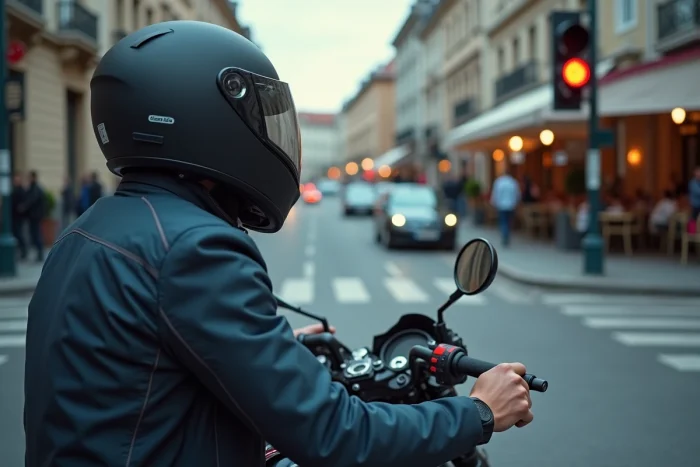
You are riding in the city on your 125 cc, you turn right, and you instinctively extend your arm instead of using the turn signal. Is this gesture, inherited from cycling, legally sufficient on a motorized two-wheeler? The answer depends on the type of vehicle, its year of registration, and sometimes the context of use. Motorcycle turn signals are subject to specific regulations, but their practical application raises questions that the law does not always clearly address.
Hyper-flash and electric motorcycles: a technical bug that the regulations did not foresee
Before discussing legal obligations, a concrete issue deserves attention. On electric motorcycles registered after 2024, the turn signals integrated into the mirrors have a recurring defect: hyper-flash. This abnormally rapid blinking occurs due to electronic control units optimized for high-voltage batteries, according to technical bulletin no. 47 from UTAC published in January 2026.
Hyper-flash does not make the turn signal unreadable, but it alters the frequency perceived by other road users. A driver may interpret this rapid blinking as a malfunction rather than an intention to turn. Hyper-flash on electric motorcycles obscures the message sent to other users.
This phenomenon also affects motorcyclists who replace their bulb turn signals with LED models without adapting the circuit’s resistance. The question raised by the topic of mandatory motorcycle turn signals or not thus goes beyond the simple legal framework: does a malfunctioning turn signal really provide protection?
Legal obligation of motorcycle turn signals: what the decree of July 16, 1954 says
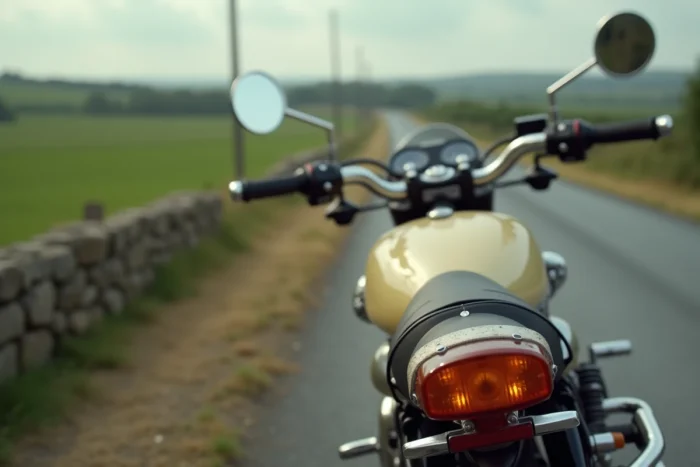
The regulatory basis remains the decree of July 16, 1954, which has been amended numerous times. This text requires all motorized vehicles operating on open roads to have functioning turn signals. Motorcycles, scooters, and mopeds are all subject to this obligation.
The nuance concerns older vehicles. A motorcycle registered before the obligation came into effect may, in certain cases, operate without turn signals if it was not originally equipped with them. The rider must then signal their changes of direction with an arm gesture.
Specific case of enduros and trial motorcycles
Motorcycles sold with a road homologation kit (mirrors, turn signals, wiring harness) raise a common question. Can you ride on the road without installing this kit? The answer is no. As soon as a two-wheeler operates on a road open to public traffic, turn signals are required. Riding “in off-road configuration” on the road exposes one to fines.
The French Federation of Angry Motorcyclists (FFMC) noted in a survey from February 2026 that cheap mini LED turn signals mounted on enduros have a reduced lifespan of 40% in off-road use due to mud and vibrations. A burnt-out turn signal on the road remains an infraction.
Motorcycle technical inspection and fines: the situation has changed since 2024
The introduction of motorcycle technical inspections in 2024 has profoundly changed the situation. Before this date, a malfunctioning turn signal was only detected during a roadside check. The likelihood of being fined for riding with a broken turn signal remained low for a motorcyclist.
Since 2024, the annual report from the Road Safety Agency (published on March 15, 2026) indicates a more than twofold increase in infractions detected for non-compliant turn signals in dense urban areas. Systematic technical inspections have made previously ignored defects visible.
- Turn signals are checked during the technical inspection: operation, blinking frequency, visibility, and attachment.
- A turn signal that hyper-flashes or remains fixed can lead to a re-inspection.
- Aftermarket mini turn signals must carry an “E” homologation marking to be accepted.
2025 decree on visibility in rain
A decree published on April 12, 2025 (n°2025-456) introduced an additional requirement: LED turn signals must meet a minimum visibility threshold under rainy conditions. This measure, currently being tested in pilot technical inspection centers, is not yet fully implemented. It targets low-end LED models whose brightness significantly drops when the lens is wet.
Turn signals in urban areas at low speed: a useful or inappropriate obligation?
You are riding at 30 km/h in a calm area, stuck between a bus and a bike lane. Do you really need a turn signal to indicate that you are maneuvering around an obstacle? The question is not provocative: it reflects a gap between regulations and current urban practices.
In urban areas, motorized two-wheelers often operate in narrow spaces where trajectory changes are constant. The turn signal, designed to indicate a turn or lane change on the road, sometimes becomes a continuous gesture and thus unreadable. When the turn signal stays on continuously, it loses its signaling function.
However, removing the obligation also makes no sense. Statistics from the Road Safety Agency show that the majority of accidents involving a two-wheeler in the city occur during direction change maneuvers. The real problem does not lie in the obligation itself, but in two concrete factors:
- The positioning of turn signals on certain motorcycles makes them poorly visible from the front, especially models where the indicators are placed very low on the fairing.
- The lack of automatic deactivation on most motorcycles (unlike cars) means that many motorcyclists forget to turn off their turn signals, creating confusion for other users.
- Motorcyclists in traffic frequently activate and deactivate their turn signals, making the signal less readable for surrounding drivers.
The problem is not the obligation but the design of motorcycle signaling systems, which has remained largely unchanged for decades while urban traffic conditions have transformed. Some manufacturers are beginning to offer automatically deactivating turn signals and wider side indicators, but these features remain minority on the market.
The French regulatory framework mandates turn signals on all motorized two-wheelers operating on open roads, with no practical exceptions in the city. The motorcycle technical inspection has reinforced this requirement since 2024, and the 2025 decree adds a visibility constraint in the rain. Riding with compliant and functional turn signals remains the only legal option, even if their real effectiveness in dense urban traffic would warrant a technical overhaul rather than a mere maintenance of the obligation.